
An Exercise in Attention
May as Well Try This at Home

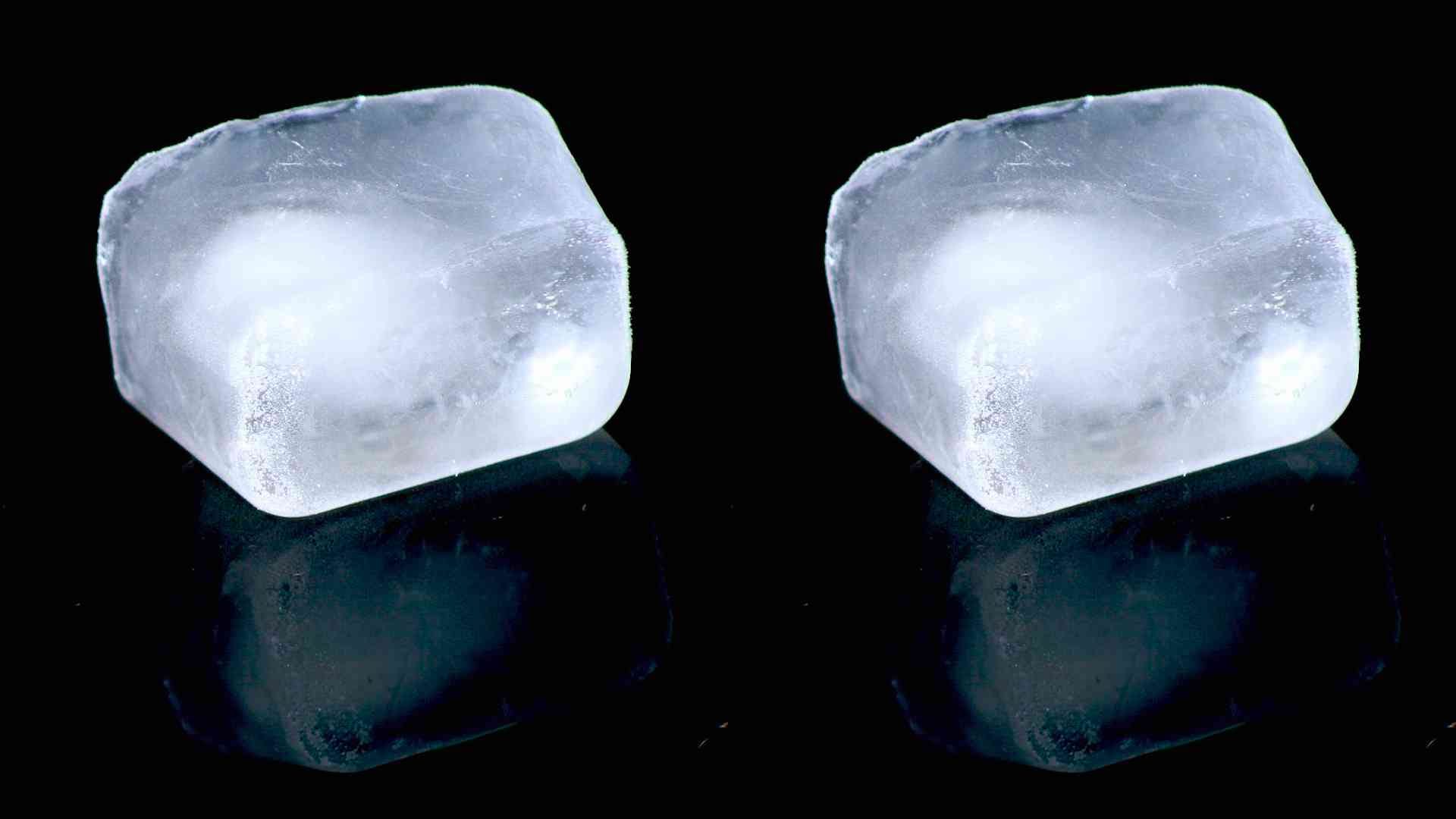
PREPARE YOURSELF FOR TWO of the most _________ hours of your life. Among the words you might choose to put in the blank here are “gripping,” “insightful,” “consciousness-expanding,” “intense,” “soulful,” “quiescent,” “tedious,” “mind-numbing,” “hollow,” “meaningless,” “excruciating,” or “other.”
First obtain some plain cotton cloth. A tea towel will be fine, certainly nothing larger. A washcloth will do. Spread the cloth on a table before which a chair has been placed. Take from the freezer a pair of ice cubes and get them to the table and place them in the center of the cloth. Go ahead and be seated with the cloth and the ice cubes directly in front of you.
It’s totally up to you, but you may want to position the ice cubes so that they are about as far apart as a set of human eyes. If they are standard, tray-style ice cubes they will perhaps suggest the lenses of a pair of eyeglasses. Note the cloudy eye floating within the center of each lens. These are clusters of air bubbles and dissolved minerals suspended in the water and trapped in position during the freezing process.
Stare into those lenses. As the thaw begins, you may see a few small air bubbles that formed around the edges appear and burst open. If it’s very quiet, you may even hear a faint popping or crackling sound as this happens. What is that sound? Is it caused by the pressure differential between the air inside the bubbles and that of the air outside of them? You will have a lot of time to meditate on this question, so don’t settle on an answer too quickly. Also, is this anything like what happens when you add milk to a bowl of Rice Krispies?
Try to return your attention to the melting ice and let thoughts of delicious breakfast foods pass on through you.
As you stare at the cubes, noting now, maybe ten or twenty minutes in, how the surfaces of the cubes have become more water-slick and glossy, you may also notice that the outer faces of the cubes have become more transparent, and that the definition that was present in their edges has softened. Are the cubes becoming imperceptibly smaller as the minutes pass, or can you actually perceive it?
You may notice, eventually, that your eyelids are becoming heavy and that you’re at risk of dozing off and losing precious minutes of melting observation. It wouldn’t hurt to warm up some of the coffee left over in the pot from this morning, even though it’s one-thirty in the afternoon and it might keep you awake later. Actually, that sounds like it could hurt you a little. Weigh the pros and cons mindfully as you ponder this: Are the ice cubes actually getting imperceptibly bigger now? How is that possible?
You are still awake. If you are now around an hour into this exercise you may be feeling frustrated and impatient. You may wonder, is there any way to move this thing along more quickly? Other than by simply taking your fists and smashing them down on the two eyeglass lens blobs on the table, maybe pulverizing them into a slush?
You can try focusing your feelings. Perhaps the heat from your anger—at the pointlessness of this exercise or at the universe itself—will move things along. Perhaps tears distilled by some private sorrow surfaced from the stillness and quiet of this exercise will fall and melt the ice cubes just a bit faster. But no. The suspense is killing you, but it seems to be having little to no effect on these ice cubes.
Although it’s really not in the spirit of the exercise, you could decide to put on a record to give your brain some traction in this moment. Otherwise, your mind just seems to be slipping around on the slippery sheen of those cubes, your eyes watering from the pain of the thoughts grasping for your attention, your eyes melting out of their sockets, their water streaming down your cheeks.
You could listen to Ahmad Jamal play piano at his own Alahambra club in Chicago in 1961. Israel Crosby on bass. Vernell Fournier on drums.
You could listen to the same trio play live at the Pershing Lounge, also in Chicago, back in 1958. Both sides, both records.
You might have thought that as the cubes of ice got smaller and their surface area to volume ratio increased that they would begin to melt faster, but this does not seem to be the case. You might have thought that the greater incidence of air bubbles in their cloudy centers might have made those parts melt faster, but this does not seem to be the case.
The needle is still skidding in the runout groove as the last cloudy pellets of ice cube eyes vanish from sight.
You may be surprised at the extent to which water has spread throughout the entirety of the tea towel. All that from just two cubes? On the other hand, you have been watching this happen pretty devotedly for over two hours, so perhaps you are not so surprised.
At this point, you may take the damp tea towel and drape it against your head and down your face. You may stand up from your chair and step away from the table and press the cool, wet towel folds into your eye sockets as you take a deep breath, hold it, and bend forward at the waist as far as you can go. This may activate your mammalian diving reflex, squeezing blood from your extremities and flooding your brain and your slowing heart. You may feel a sudden sensation of peace and calm and a sense of descending through the breathless dark.
The Belgian surrealist René Magritte painted many pictures that appear to be frozen in time. He was thirteen years old in March of 1912 when his mother drowned herself in the River Sambre in Châtelet. It was not her first attempt at suicide.
Legend says that young René was there to see her as she was removed, her face covered by her sopping skirts. The truth of this account has been debunked by recent scholarship, but the implication was that this experience prefigured his later series of paintings, Les Amants [The Lovers], which show a man and a woman—their heads draped in white cloth—in what would otherwise be fairly romantic portraits.
The couple are performing what would be, if not for the layers of cloth between their lips, a kiss. Or they are standing next to one another, their heads and shoulders so close that were it not for the cloth that separates them they would be touching.
As you stand bent double, your breath suspended and your face covered with cloth, you may imagine that you drift down, alone, to the bottom of the cold, rushing river, your limbs freezing in the winter water, your eyes freezing into cloudy balls of ice.
“Everything we see hides another thing. We always want to see what is hidden by what we see,” Magritte is said to have said. And: “We must not fear daylight just because it almost always illuminates a miserable world.”
You may remind yourself that René Magritte lived to the age of 68 and was married to his wife Georgette for 45 years. Paul Simon wrote a song about them, and it was good!
Despite experiencing the usual ups and downs of life, financial insecurities, spiritual uncertainties, an affair with a young performance artist and Georgette’s subsequent affair with a close buddy of his—who René himself had engaged to keep her happily occupied while he dallied with his young lover—there is every reason to believe that Magritte died a happy old man.
Image by Anderson Mancini via Wikimedia Commons.
.jpg)
I found this piece sort of mesmerizing... the most accurate word I can conjur. I could see the melting, feel the water. Made me ponder.
This affected me, even in the wasteful minutes I give myself on Monday mornings. You fucker.